
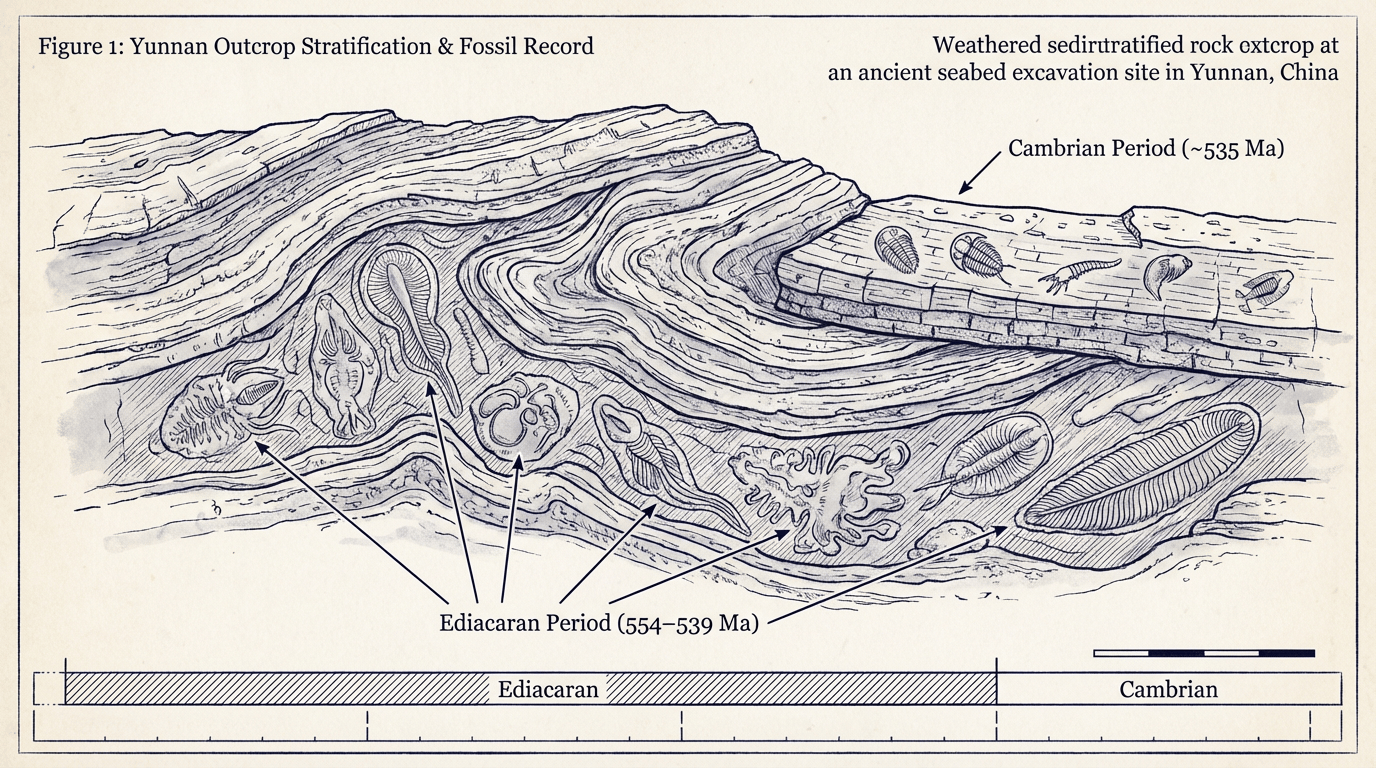
KUNMING, China — Newly analyzed fossils from China’s Jiangchuan Biota indicate that complex animal groups were already diversifying in the late Ediacaran period, shifting this evolutionary transition at least four million years earlier than the classic start of the Cambrian explosion, according to reporting from The Associated Press, University of Oxford, Science News, Discover Magazine, Earth.com, and Phys.org. Each of the bullet points immediately below have been confirmed by at least four of the six respected sources we curated on this story.
- Researchers report more than 700 fossils from the Jiangchuan Biota in Yunnan, southwest China, dated to roughly 554 to 539 million years ago near the end of the Ediacaran period.
- The findings place multiple complex animal forms before the Cambrian period, pushing this diversification timeline back by at least four million years from the long-used ~535 million-year benchmark.
- The fossil set includes organisms interpreted as early relatives of deuterostomes, the broader lineage that later includes vertebrates, along with forms tied to early ambulacrarians.
- Scientists describe the site as a transitional community between late Ediacaran biota and better-known Cambrian faunas, helping close a major gap between molecular-clock expectations and fossil evidence.
- Unlike many Ediacaran sites that preserve surface impressions, Jiangchuan fossils are preserved as carbonaceous films, allowing finer anatomical detail such as feeding structures and internal features to be studied.
Additional Details Reported
Interpretation debate
The Associated Press reported that while most outside experts it contacted viewed the fossils as evidence of complex animals, at least one outside researcher questioned whether the current evidence is sufficient for all interpretations.
What comes next in the record
Science News said paleontologists now want tighter evolutionary placement of the newly described forms, while Discover Magazine highlighted researchers’ view that the find opens a broader search for similarly preserved late-Ediacaran communities that may still be undiscovered.
Image Attribution
Attribution: AI-generated image (Hedra.com for EOBS.biz)
How we report: We select the day’s most important stories, confirm facts across multiple reputable sources, and avoid anonymous sourcing. Our goal is clear, balanced coverage you can trust—because transparency and verification matter for informed readers.