
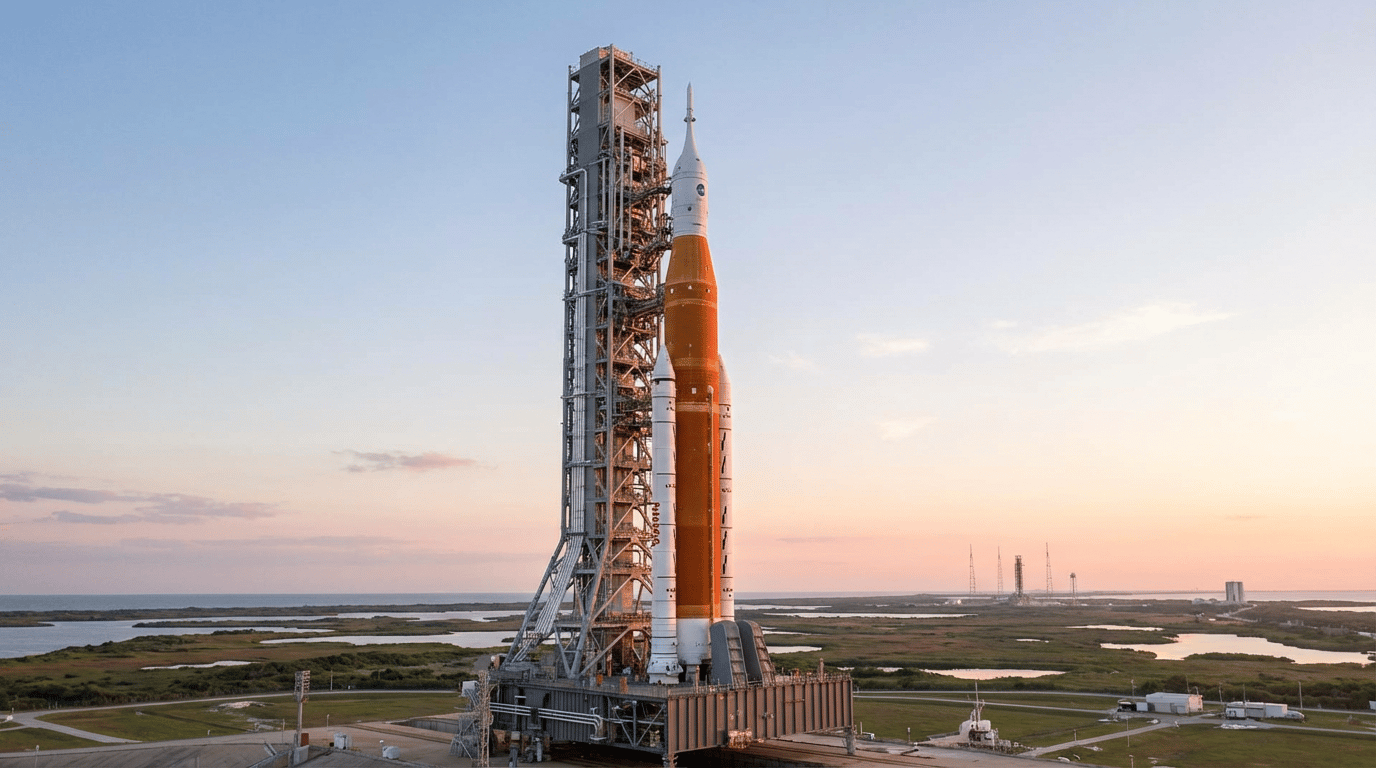
CAPE CANAVERAL, Fla. — NASA’s Artemis II Space Launch System rocket and Orion spacecraft arrived at Launch Pad 39B at Kennedy Space Center on Friday, completing an 11-hour journey from the Vehicle Assembly Building as the agency prepares for its first crewed lunar mission in more than five decades. The mission is now targeting a launch window opening April 1, with four astronauts set to embark on a 10-day journey around the Moon. Coverage of this story was drawn from NASA, Space.com, The Guardian, Live Science, Aviation Week, and Reuters. Each of the bullet points immediately below have been confirmed by at least four of the six respected sources we curated on this story.
Core Facts
- The 322-foot-tall Space Launch System rocket and Orion capsule arrived at Launch Complex 39B on March 20, 2026, following an approximately 11-hour rollout from the Vehicle Assembly Building that began at 12:20 a.m. EDT
- The 4-mile journey was conducted by NASA’s crawler-transporter 2 vehicle, which moves at a maximum speed of 0.82 mph to maintain stability of the 11-million-pound stack
- The mission is now scheduled to launch during a window opening April 1, 2026, with additional opportunities available through April 6
- Artemis II is a 10-day crewed mission that will travel around the Moon, marking the first human lunar mission since the Apollo era ended in 1972
- The four-person crew consists of NASA astronauts Reid Wiseman (commander), Victor Glover (pilot), and Christina Koch (mission specialist), along with Canadian Space Agency astronaut Jeremy Hansen (mission specialist)
- The rocket was rolled back to the Vehicle Assembly Building for approximately 23 days of servicing to address technical issues including helium flow interruptions and hydrogen fuel leaks discovered during earlier wet dress rehearsals
- This represents NASA’s first crewed flight of the Artemis program, which aims to establish a sustained human presence on the Moon as a stepping stone for future Mars missions
Additional Details Reported
The astronauts entered pre-flight quarantine in Houston on March 18, two days before the rollout, as part of standard protocols to ensure crew health prior to launch. The March 20 rollout was delayed approximately four hours from its initial schedule due to high winds in the Cape Canaveral area.
This marks the second time in 2026 that the Artemis II stack has been transported to the launch pad, following an initial rollout on January 17. The rocket will undergo final testing and preparations at the pad before NASA confirms a specific launch date within the April window.
The Artemis II mission will test critical systems for future lunar landing missions, with the crew traveling approximately 4,700 miles beyond the far side of the Moon—surpassing the distance record set by Apollo 13 in 1970.
How we report: We select the day’s most important stories, confirm facts across multiple reputable sources, and avoid anonymous sourcing. Our goal is clear, balanced coverage you can trust—because transparency and verification matter for informed readers.
Image Attribution
Description: NASA’s massive Artemis II Space Launch System rocket stands at Launch Pad 39B at Kennedy Space Center, preparing for humanity’s first crewed mission to the Moon in over 50 years. The 322-foot tall rocket will carry four astronauts on a 10-day journey around the Moon in April 2026. Style: modern editorial illustration with clean lines, balanced palette, dramatic but realistic lighting suggesting dawn/pre-launch atmosphere.
(Artificial intelligence created image: Hedra.com / EOBS.biz)