
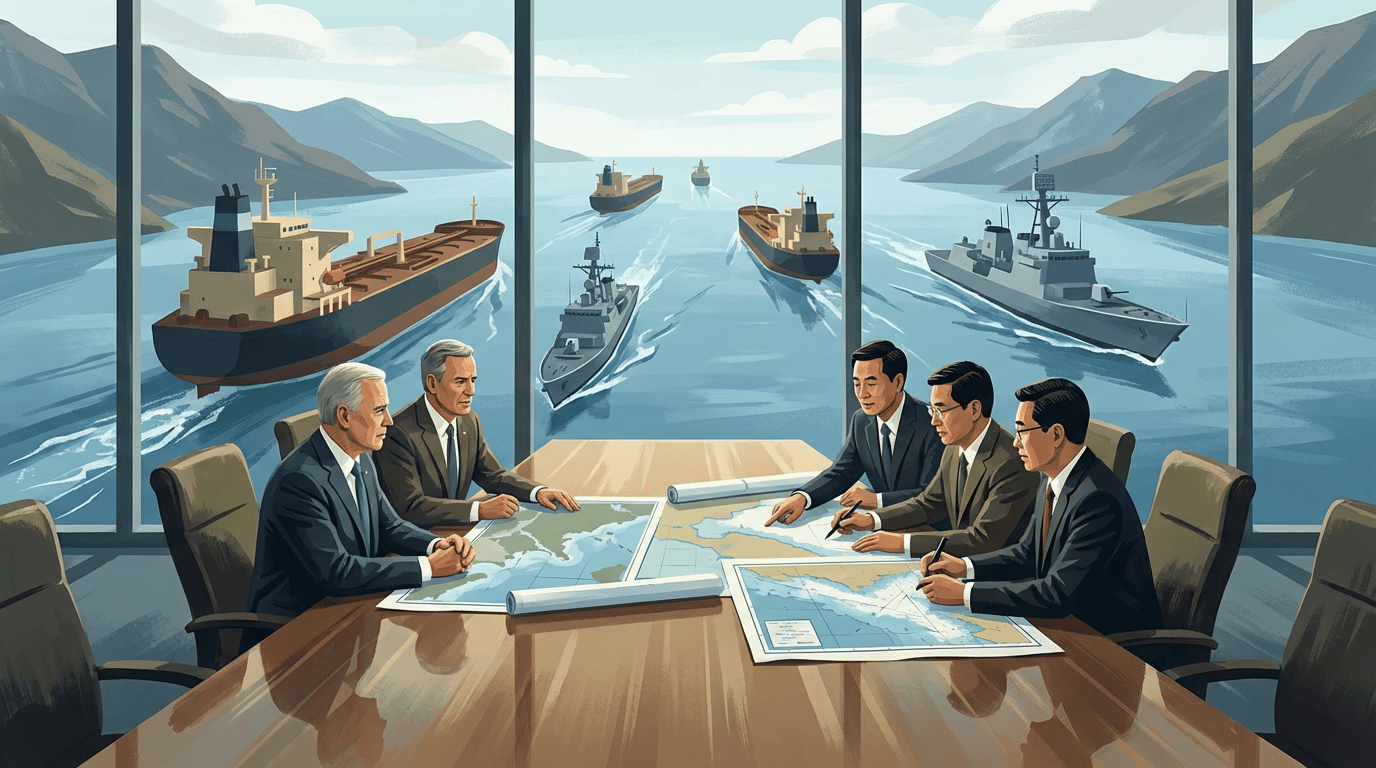
WASHINGTON — President Donald Trump is actively seeking international assistance to secure the Strait of Hormuz amid the escalating U.S.-Israeli war with Iran, asking China and approximately half a dozen other nations to contribute warships to reopen the vital waterway through which one-fifth of the world’s traded oil flows. The diplomatic push represents a significant shift from the administration’s initial unilateral approach to the conflict, as Trump now confronts the economic and geopolitical consequences of a region in turmoil. Each of the bullet points immediately below have been confirmed by at least four of the six respected sources we curated on this story.
• Trump has asked roughly six countries — including China, Japan, South Korea, Britain, and France — to send warships to help secure the Strait of Hormuz and allow oil tanker traffic to resume
• The president indicated he would use his long-planned late-March summit with Chinese President Xi Jinping to pressure Beijing into joining a coalition to reopen the strait, but revealed Monday he has asked China to delay the trip by “a month or so” due to the war
• So far, no country has committed to participating in the naval coalition, with European allies expressing skepticism and China remaining noncommittal
• Iran has effectively blocked the Strait of Hormuz for U.S., Israeli, and allied vessels while allowing its own oil shipments to allies like India and China to continue
• Oil prices have soared above $100 per barrel as a result of the strait’s closure and the ongoing military conflict, creating economic pressure on consuming nations
• Trump warned that it would be “very bad for the future of NATO” if allies do not help secure the waterway, while simultaneously claiming the United States doesn’t need help because “we’re the strongest nation in the world”
• U.S. Secretary of State Marco Rubio told South Korean Foreign Minister Cho Hyun on Monday that cooperation to secure the strait is “more important than ever to stabilize the global economy and oil prices”
• Treasury Secretary Scott Bessent downplayed any connection between a potential summit delay and disputes over the strait, stating any postponement would be due to “logistics” rather than diplomatic disagreements
Additional Details Reported
The Trump administration’s diplomatic pivot comes after the president largely side-stepped international coordination when making the initial decision to launch strikes on Iran alongside Israel. The war, which began February 28, has seen sustained attacks across Iran and retaliatory strikes throughout the Middle East, roiling global energy markets and displacing civilians.
European leaders have shown little appetite for military involvement in the strait. German Defence Minister Boris Pistorius bluntly stated, “This is not our war. We have not started it,” and questioned what European frigates could accomplish that the U.S. Navy cannot. German Chancellor Friedrich Merz’s spokesman emphasized that NATO “was created as a defensive alliance” and was not designed for “one of the allies to go on a war of choice and then oblige everybody else to follow.”
British Prime Minister Keir Starmer said Monday that Britain is working with allies on a plan to reopen the strait but stressed the UK “will not be drawn into the wider war.” Britain is discussing the possibility of deploying mine-hunting drones already in the region, though no British warship would be dispatched.
French President Emmanuel Macron has expressed willingness to help unblock the strait, but only once the “hottest phase” of the conflict is over. France has suggested the EU could expand its Operation Aspides mission, though foreign ministers declined to extend the existing naval operation during a Monday meeting in Brussels.
China’s Foreign Ministry spokesperson Lin Jian did not directly respond to questions about Trump’s call for assistance, instead noting the impact on goods and energy trade and repeating Beijing’s call for an end to the fighting. The potential delay of the Trump-Xi summit carries its own economic implications, as U.S.-China relations remain fraught over tariffs and trade disputes.
Vice President JD Vance expressed support Monday for Trump’s handling of the war, saying he trusted the president to ensure “the mistakes of the past” are not repeated. The administration has also urged U.S. diplomats abroad to push allies to designate Iran’s Islamic Revolutionary Guard Corps and Hezbollah as terrorist groups, citing elevated risk of attack.
Image Attribution
Artificial Intelligence generated image / EOBS.biz
How we report: We select the day’s most important stories, confirm facts across multiple reputable sources, and avoid anonymous sourcing. Our goal is clear, balanced coverage you can trust—because transparency and verification matter for informed readers.