
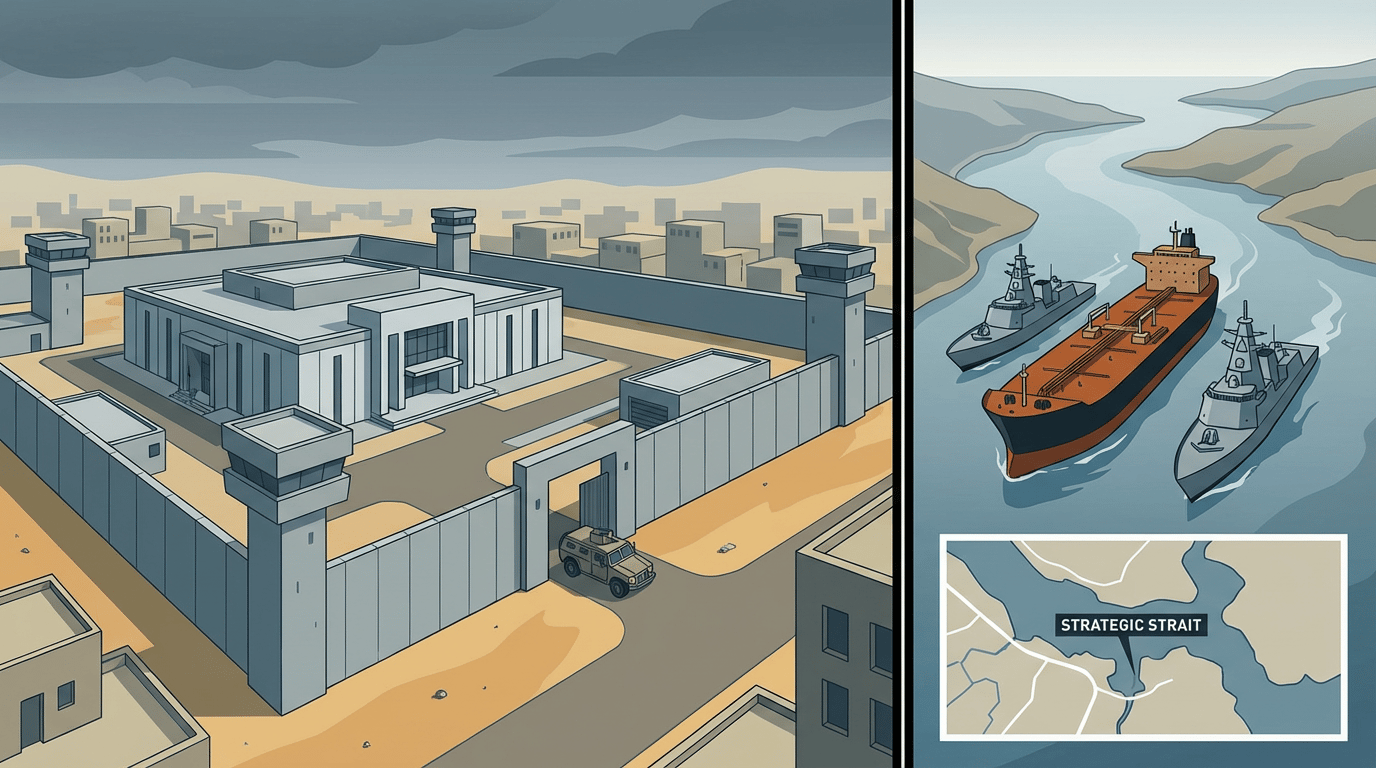
WASHINGTON — The United States embassy in Baghdad was hit by a drone and rocket attack early Tuesday as President Donald Trump appealed for international military assistance to secure the Strait of Hormuz amid the escalating Iran war, while key European allies publicly rejected joining any naval coalition. Accounts from AP News, BBC News, The New York Times, Al Jazeera, The Guardian, and Reuters detail the intensifying regional conflict and the diplomatic tensions emerging between Washington and its traditional partners. Each of the bullet points immediately below have been confirmed by at least four of the six respected sources we curated on this story.
- The US embassy in Baghdad, located in the heavily fortified Green Zone, was attacked by three drones and four rockets early Tuesday, with at least one drone striking inside the embassy compound. Iraqi security officials described the assault as the most intense attack on the embassy since the current conflict began.
- The United Arab Emirates temporarily closed its airspace on Monday due to missile threats and drone attacks from Iran, with operations returning to normal later Tuesday after Iranian projectiles targeted Dubai International Airport and the strategically important Fujairah port, one of the region’s largest oil storage facilities.
- President Trump has called for an international naval coalition to secure the Strait of Hormuz, identifying China, France, Japan, South Korea, the United Kingdom, and NATO members as countries that should contribute military assets to keep the vital waterway open.
- European leaders have publicly rejected military participation in the Hormuz coalition, with Germany, Italy, and other NATO allies ruling out sending warships, while UK Prime Minister Keir Starmer stated Britain would not be drawn into the wider war despite considering aerial minesweeping drone support.
- Oil prices have surged dramatically since Iran announced it would target ships using the strait, with Brent crude jumping to over $100 per barrel from approximately $65, raising concerns about global inflation and economic growth.
- Iran has launched more than 1,900 missiles and drones at the UAE since the war began, targeting transport and oil infrastructure and causing major disruptions at Dubai International Airport, the world’s busiest international transit hub.
Additional Details Reported
The attack on the US embassy represents a significant escalation in the conflict. According to witnesses, at least three drones were seen flying toward the embassy compound Monday night into Tuesday morning. While Iraqi defense systems intercepted two of the drones, one managed to crash inside the embassy grounds, according to a security official who spoke with AFP and was cited by BBC News and other outlets.
The Green Zone, where the embassy is located, houses both Iraqi government buildings and foreign diplomatic missions. The area has come under repeated fire since the conflict began, with a drone sparking a fire at a luxury hotel in the zone just days earlier.
Trump has expressed frustration with allies who have declined to join the Hormuz coalition. “Some are very enthusiastic about it, and some aren’t,” he told reporters Monday, adding that “some are countries that we’ve helped for many, many years.” Without naming specific countries, he pointed to one apparent rebuff where a nation with 45,000 US troops protecting it was unwilling to provide even mine sweepers.
The US president singled out the United Kingdom specifically, saying he was “very surprised” by Starmer’s reluctance. “You’re our oldest ally, and we spend a lot of money on Nato and all of these things to protect you,” Trump said, referencing the UK’s decision not to send ships despite his direct request two weeks ago.
Starmer, for his part, maintained that his decisions were guided by principle. “While taking the necessary action to defend ourselves and our allies, we will not be drawn into the wider war,” he said at a Downing Street press conference. The Guardian reported that Starmer’s refusal to allow Trump to use British bases to launch the initial attack on Tehran had already strained the relationship between the two leaders.
France has indicated more willingness to help than other European nations, though Paris has not committed specific military assets. South Korea and the UK have said they are reviewing the situation, with Starmer mentioning discussions about offering aerial minesweeping drones rather than naval vessels.
The economic implications of the strait closure extend beyond oil prices. The Guardian noted that Britain’s last minesweeping ship in the region, HMS Middleton, left Bahrain for maintenance days before the war began, a timing issue now at the center of internal government debate.
Meanwhile, the human toll of the conflict continues to mount. Al Jazeera reported that Israel-Hezbollah fighting has displaced approximately one million people in Lebanon, while the AP noted ongoing concerns about civilian casualties from strikes across the region.
Image Attribution
Artificial Intelligence generated image / EOBS.biz
How we report: We select the day’s most important stories, confirm facts across multiple reputable sources, and avoid anonymous sourcing. Our goal is clear, balanced coverage you can trust—because transparency and verification matter for informed readers.