
UTRECHT, Netherlands — Researchers analyzing Atlantic Ocean water samples estimate that about 27 million metric tons of plastic exists as nanoplastics—particles smaller than a micrometer—suggesting the tiniest fragments may make up a dominant share of marine plastic pollution, according to NIOZ, Utrecht University, European Commission, EurekAlert!, Marine Technology News and ScienceDaily. Each of the bullet points immediately below have been confirmed by at least four of the six respected sources we curated on this story.
- The new basin-scale estimate puts the mass of North Atlantic nanoplastics in the mixed layer (upper ocean) at roughly 27 million metric tons.
- The research focuses on nanoplastics smaller than 1 micrometer—quantified by filtering out anything larger than 1 micrometer before analysis.
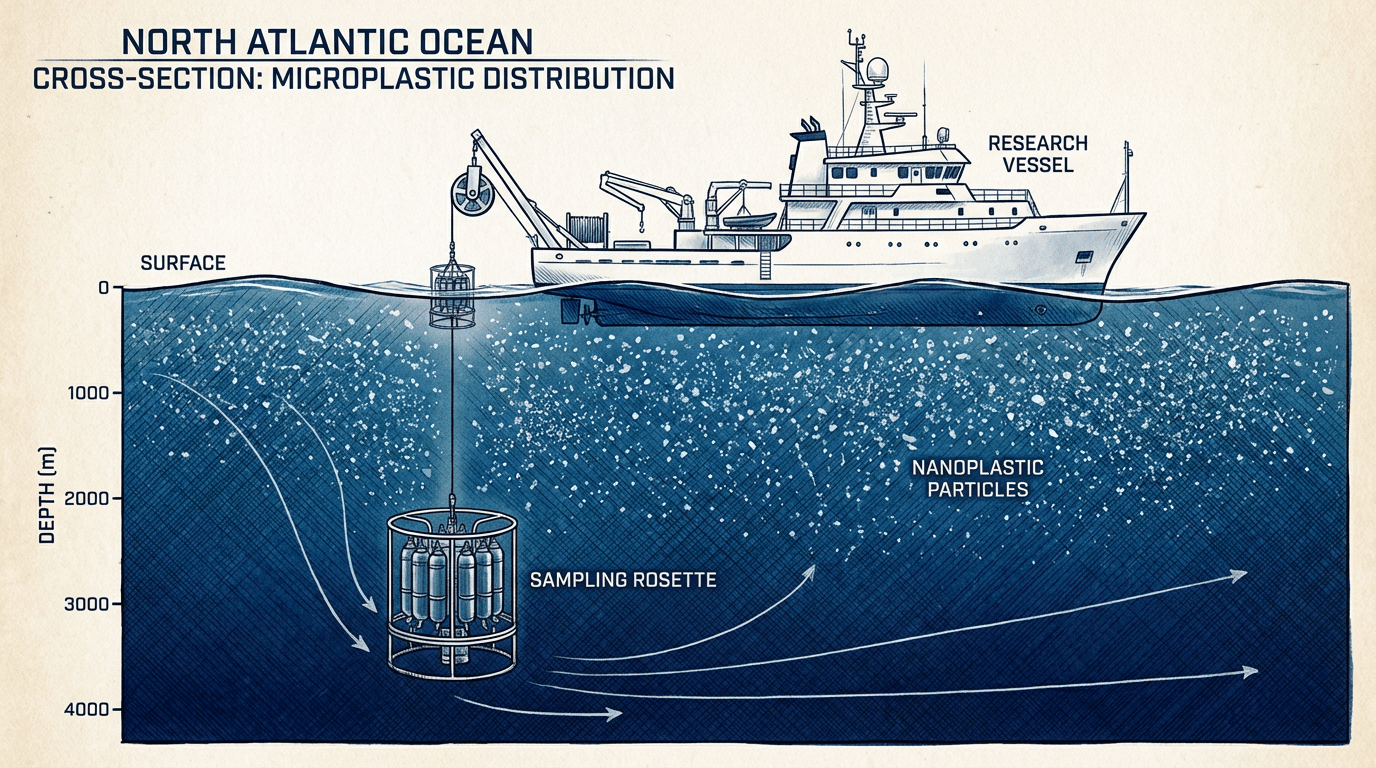
- Sampling was conducted at 12 stations across the North Atlantic aboard the research vessel RV Pelagia; collected water was filtered to remove particles larger than 1 micrometer before analysis.
- The team used mass spectrometry to identify plastic-specific chemical fingerprints in the remaining material, enabling one of the first quantitative ocean-basin assessments of nanoplastics.
- Researchers say the estimate suggests nanoplastics in this part of the Atlantic may be comparable to—or greater than—previous estimates for larger macro- and microplastic pollution, reshaping the marine plastic mass budget.
- Because nanoplastics are widely dispersed and effectively impossible to remove at scale, scientists and policy analysts emphasize prevention—reducing plastic leakage into the environment—as the most realistic response.
Additional Details Reported
Where the smallest plastics were measured
Technical summaries of the work describe sampling across multiple depths, including near-surface water, intermediate depths, and near-bottom waters, with nanoplastics detected throughout the surveyed water column. The available summaries also describe higher average concentrations near the surface than at depth, consistent with surface inputs and mixing patterns. (See: European Commission.)
What the study says about materials and methods
In the paper’s abstract and supporting summaries, researchers report that the sub-micrometer fraction they quantified was dominated by specific polymers such as polyethylene terephthalate (PET), polystyrene, and polyvinyl chloride (PVC), while some common plastics were notably harder to detect in the smallest size range. A press briefing describing the work also highlights a thermal-desorption, proton-transfer-reaction mass spectrometry approach that can distinguish polymers by their chemical fingerprints. (See: Utrecht University and EurekAlert!.)
Several reports also frame the findings as a partial answer to the long-running “missing plastic” paradox—why measured ocean plastic has historically fallen short of estimates of how much plastic enters marine systems—because larger debris can fragment into ever-smaller particles that are difficult to quantify and retrieve.
Image Attribution
Attribution: AI-generated image (Hedra.com for EOBS.biz)
How we report: We select the day’s most important stories, confirm facts across multiple reputable sources, and avoid anonymous sourcing. Our goal is clear, balanced coverage you can trust—because transparency and verification matter for informed readers.