
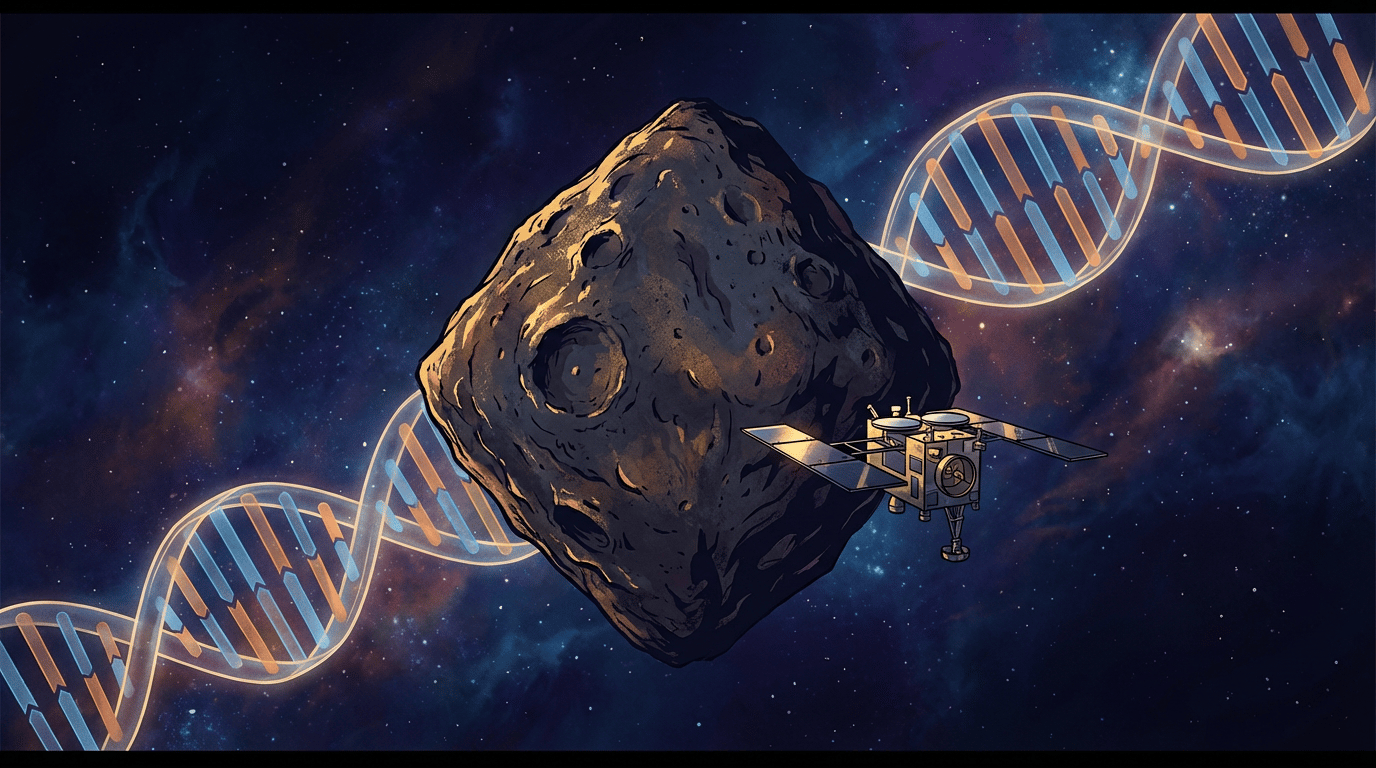
TOKYO, Japan — Samples from the asteroid Ryugu contain all five canonical nucleobases—the fundamental molecular components of DNA and RNA—according to a study published in Nature Astronomy by an international research team led by Japanese scientists. Nature Asia, Astrobiology.com, Sci.News, Nippon.com, The Jerusalem Post, and Space.com contributed reporting to this story. Each of the bullet points immediately below have been confirmed by at least four of the six respected sources we curated on this story.
Core Facts
- All five canonical nucleobases—adenine, guanine, cytosine, thymine, and uracil—were detected in samples collected from the carbonaceous asteroid Ryugu by Japan’s Hayabusa2 mission, marking the first time the complete set has been confirmed in pristine extraterrestrial material from a primitive asteroid.
- The samples were retrieved by the Japan Aerospace Exploration Agency’s Hayabusa2 spacecraft, which touched down twice on Ryugu’s surface in 2019 and returned approximately 5.4 grams of material to Earth in December 2020.
- The research, led by biogeochemist Toshiki Koga from the Japan Agency for Marine-Earth Science and Technology, was published in the journal Nature Astronomy on March 16, 2026, following analysis of approximately 20 milligrams of Ryugu sand using water and hydrochloric acid extraction methods.
- Ryugu, classified as a C-type or carbonaceous asteroid, is considered a relatively unaltered remnant from the solar system’s formation approximately 4.6 billion years ago, containing organic matter and water from the earliest period of planetary development.
- Comparative analysis reveals Ryugu contains roughly comparable amounts of purine nucleobases (adenine and guanine) and pyrimidine nucleobases (cytosine, thymine, and uracil), a distinct profile from the Murchison meteorite, which shows higher purine abundance, and from asteroid Bennu and the Orgueil meteorite, which are richer in pyrimidines.
- The universal detection of all five nucleobases in samples from carbonaceous asteroids Ryugu and Bennu suggests these compounds are widespread throughout the Solar System and that carbonaceous asteroids may have contributed to the organic inventory of early Earth.
Additional Details Reported
Previous analyses of Ryugu samples had detected only uracil due to limited material availability. The latest findings represent the most comprehensive detection of nucleobases in extraterrestrial samples from a primitive asteroid to date.
The differences in nucleobase ratios between Ryugu, Bennu, Murchison, and Orgueil reflect the distinct chemical, environmental, and evolutionary histories of their respective parent bodies, including factors such as ammonia availability, presence and longevity of liquid water, temperature regimes, and duration of synthesis.
The detection builds upon previous findings from NASA’s OSIRIS-REx mission to asteroid Bennu, which also yielded all five canonical nucleobases. Both Ryugu and Bennu are C-type asteroids, strengthening the hypothesis that these bodies may have delivered molecular precursors relevant to the emergence of life through impacts on early Earth.
Researchers emphasize that analyzing pristine asteroid samples—those not exposed to Earth’s atmosphere—holds high scientific value for accurately assessing nucleobase distributions and their isotopic compositions in extraterrestrial materials.
How we report: We select the day’s most important stories, confirm facts across multiple reputable sources, and avoid anonymous sourcing. Our goal is clear, balanced coverage you can trust—because transparency and verification matter for informed readers.
Image Attribution ▾
Description: STORY SUMMARY (1–2 sentences):
Scientists analyzing samples from asteroid Ryugu discovered all five DNA/RNA nucleobases, suggesting life’s building blocks may have cosmic origins. The Japanese Hayabusa2 mission retrieved these ancient samples from a carbon-rich asteroid.
MUST INCLUDE (core cues):
– Asteroid Ryugu (diamond-shaped space rock with rugged surface)
– DNA helix or molecular structure
– Space setting with stars
– Japanese Hayabusa2 spacecraft nearby
DO NOT INCLUDE (avoid misleading visuals):
– Alien creatures or life forms
– Earth landscapes
– Human astronauts
– Generic asteroids that don’t match Ryugu’s distinctive shape
STYLE:
– Modern editorial illustration, clean lines, balanced palette
– Scientific yet artistic visualization
– Deep space blues and purples with golden/amber accents for the asteroid
– 16:9 aspect ratio
(Artificial intelligence created image: Hedra.com / EOBS.biz)