
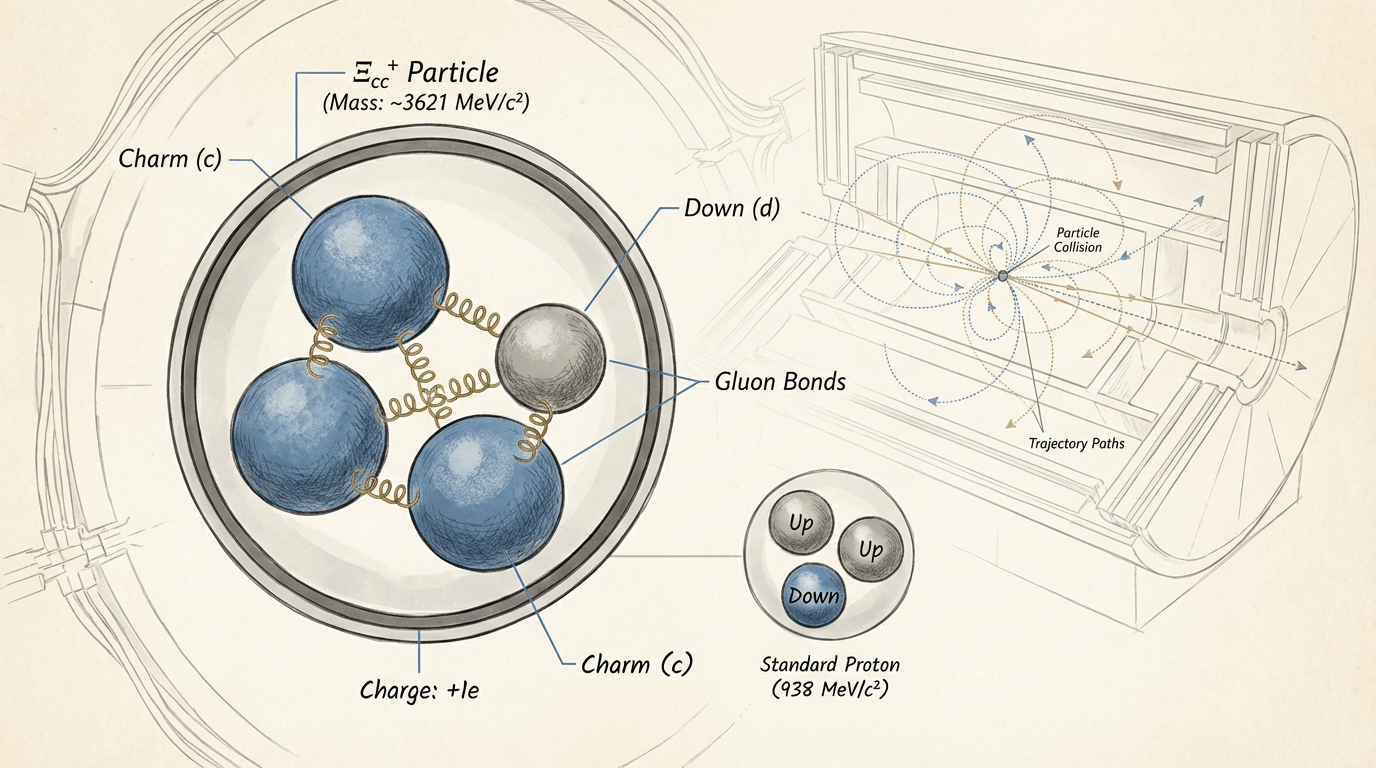
Geneva — Scientists at CERN’s Large Hadron Collider have discovered a new subatomic particle that serves as a heavy cousin to the proton, marking the first particle found using the facility’s upgraded detector system. The particle, designated Ξcc⁺ (Xi-cc-plus), contains two charm quarks and one down quark, making it approximately four times heavier than a conventional proton. This finding resolves a two-decade mystery surrounding earlier unconfirmed claims and provides physicists with a powerful new tool for testing quantum chromodynamics, the theory that describes how the strong nuclear force binds quarks together. Sources: CERN Phys.org Gizmodo Science Daily LHCb Outreach University of Manchester. Each of the bullet points immediately below have been confirmed by at least four of the six respected sources we curated on this story.
Core Facts
- The newly discovered particle is designated Ξcc⁺ (Xi-cc-plus), representing a previously unobserved member of the baryon family of subatomic particles.
- The particle contains two charm quarks and one down quark, a configuration that distinguishes it from ordinary protons, which contain two up quarks and one down quark.
- The Ξcc⁺ particle is approximately four times heavier than a standard proton due to the presence of two massive charm quarks in its structure.
- Scientists detected the particle using the upgraded LHCb detector at CERN’s Large Hadron Collider, which completed its enhancement program in 2023.
- This discovery marks the first new particle identification since the LHCb detector upgrade and represents approximately the 80th hadron discovered through LHC experiments.
Additional Details Reported
Researchers from the University of Manchester played a key role in the discovery, continuing a legacy of particle physics research at the institution that dates back to Ernest Rutherford’s identification of the proton itself between 1917 and 1919. The detection was made possible by analyzing data from proton-proton collisions that occurred during 2024, the first full year of operation for the upgraded LHCb detector.
The particle’s existence resolves a mystery spanning more than two decades. In 2002, physicists at Fermilab in Illinois reported hints of a particle that might be the Ξcc⁺, but their measurements showed a mass significantly lighter than theoretical predictions, and the confidence level fell short of the five-sigma standard required for a confirmed subatomic discovery. The new LHCb measurements place the particle at a mass that aligns with theoretical expectations.
Detection of the Ξcc⁺ required sophisticated indirect observation methods, as the particle exists for only a tiny fraction of a second before decaying. Scientists identified approximately 915 decay events where the particle transformed into three lighter particles: a Λc⁺ baryon, a K⁻ meson, and a π⁺ meson. The statistical significance of the discovery exceeds seven sigma, well above the threshold typically required in particle physics.
The discovery follows the 2017 identification of a related particle, the Ξcc⁺⁺, which contains two charm quarks and one up quark. The newly found Ξcc⁺ differs by containing a down quark instead of an up quark, a substitution that results in a predicted lifetime up to six times shorter than its counterpart due to complex quantum effects, making it significantly more challenging to observe.
The finding provides valuable data for testing models of quantum chromodynamics, particularly regarding how quarks bind together under the strong nuclear force. Particles containing multiple heavy quarks offer unique test systems for these theories because their internal dynamics differ substantially from those of lighter baryons.
How we report: We select the day’s most important stories, confirm facts across multiple reputable sources, and avoid anonymous sourcing. Our goal is clear, balanced coverage you can trust—because transparency and verification matter for informed readers.
Image Attribution ▾
Subject: A detailed cross-section visualization of the Ξcc⁺ particle, showing its internal structure consisting of two charm quarks and one down quark held together by gluon bonds. The particle is depicted as a heavy, dense cluster compared to a standard proton. Composition: Centered diagrammatic layout with a 16:9 aspect ratio, featuring thin technical lines and annotations indicating mass and charge. Action: Subatomic particles colliding in the background, leaving faint, spiraling trajectory paths suggestive of a Large Hadron Collider experiment. Location: A clean, abstract representation of the CERN Large Hadron Collider detector environment. Style: Professional scientific journal illustration, detailed technical ink-and-wash aesthetic, blueprint-style diagram with a neutral color palette and subtle blue and gold accents for particle paths. Camera & Lighting: Flat, even lighting typical of a technical schematic, high clarity, and sharp focus on the central particle structure. Factual Constraints: Ensure the particle represents three quarks (two charm, one down) to maintain scientific accuracy regarding the Ξcc⁺ discovery. (Artificial Intelligence generated image Hedra.com/EOBS.biz)