
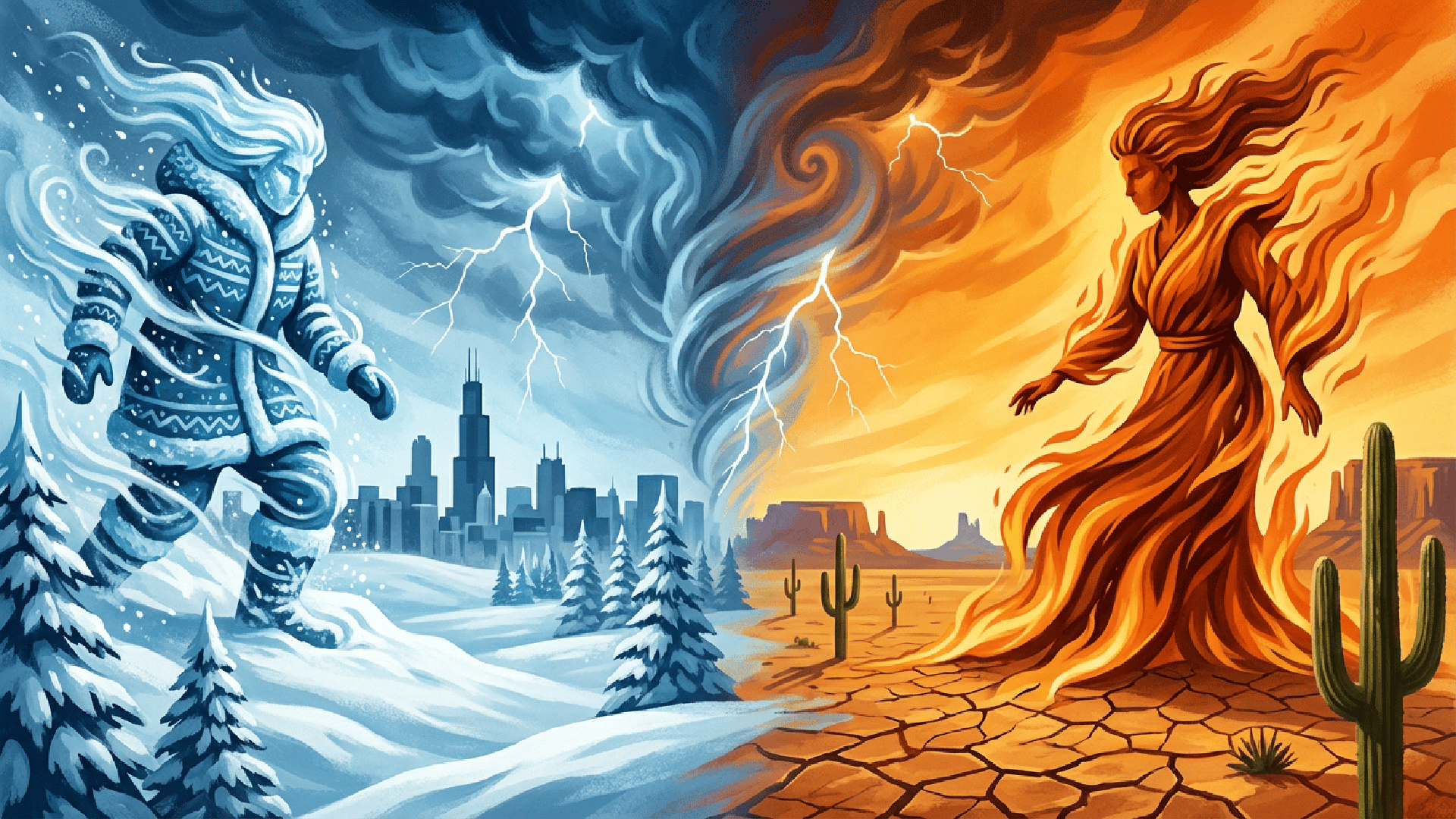
WASHINGTON — Severe weather ranging from blizzards in the Upper Midwest to tornado threats across the East Coast and triple-digit heat in the Southwest has put more than half of the U.S. population in the path of extreme conditions, forcing thousands of flight cancellations, widespread power outages, and school closures across multiple states. Reports from Associated Press, BBC News, The Guardian, USA Today, CBS News, and FOX Weather confirm the storm system is affecting approximately 200 million Americans with a dangerous mix of winter weather, severe thunderstorms, and record-breaking heat. Each of the bullet points immediately below have been confirmed by at least four of the six respected sources we curated on this story.
- More than 200 million people across the United States are under some form of weather warning or watch, ranging from blizzard conditions to extreme heat advisories
- Blizzard conditions have buried parts of Michigan, Wisconsin, and Minnesota with nearly 3 feet (0.9 meters) of snow since the weekend, with whiteout conditions making travel treacherous and potentially life-threatening
- Over 34 million people were under tornado watches stretching from Florida to New Jersey, with severe thunderstorms expected to bring high winds, hail, and possible tornadoes to the Mid-Atlantic region
- Nearly 4,400 flights were cancelled and almost 10,500 delayed nationwide by Monday evening, with Chicago’s O’Hare International Airport and New York’s LaGuardia Airport experiencing the bulk of disruptions
- More than 360,000 customers were without power across the affected regions, with Michigan, Florida, and North Carolina among the hardest-hit states
- A heat dome over the Southwest is pushing temperatures into triple digits in Arizona, with Phoenix expected to experience five consecutive days above 100°F (37.8°C) — a March record that has only occurred once before in 1988
- Temperatures in the San Francisco Bay Area and Sacramento are expected to reach near 90°F (32°C) by midweek, with Los Angeles potentially hitting 100°F (37.8°C) despite it technically still being winter
- Unrelenting rains in Hawaii triggered landslides, washed away roads, and flooded homes and farmland, with some parts of Maui receiving nearly 24 inches (61 centimeters) of rain — shattering records dating back to 1951
- Multiple wildfires in Nebraska have consumed more than 1,140 square miles (2,953 square kilometers) of mostly grassland, becoming the largest wildfire in state history
- The storm system is expected to move off the East Coast into the Atlantic by Tuesday, leaving sharply colder weather in its wake with wind chills below freezing reaching the Gulf Coast and Florida Panhandle
Additional Details Reported
In Washington, D.C., the House and Senate postponed votes, and federal agencies told workers to go home early as a tornado watch was issued for the capital region. The Washington Monument closed early at 1:00 p.m. local time as a precaution. However, by late afternoon, the expected severe weather had failed to develop in the immediate D.C. area and the tornado watch expired.
The National Weather Service warned that wind was the primary threat from the storm system, but noted that “within any of these areas of strong wind there could be some embedded tornadoes.” The biggest tornado threat stretched from Maryland to the upper edge of South Carolina.
In New York City, four people, including a child, died Monday afternoon after a fire in a three-story apartment building spread during heavy winds. The fire highlighted the dangerous combination of high winds and urban infrastructure.
Minnesota Governor Tim Walz authorized the state’s National Guard to support emergency operations as the state dealt with over 25 inches (63.5 cm) of snow in some areas. Schools in Minneapolis, St. Paul, and other districts were closed Monday, with some Wisconsin districts also shuttered.
In North Carolina, where wind gusts on Monday were predicted to exceed 74 mph (119 km/h), Governor Josh Stein encouraged residents to enable emergency alerts on their phones. Schools in Raleigh and Chapel Hill were closed as a precaution.
Los Angeles Mayor Karen Bass addressed the unusual March heat, stating: “This is technically still winter. This is not normal for March, obviously, but it is a sign of how climate change is impacting our city.” While temperatures are expected to reach 100°F, the threat of wildfires around Los Angeles is relatively low because winds will be light.
AccuWeather meteorologist Dan DePodwin characterized the Southwest heat wave as unprecedented: “This is a heat wave that we have not seen before in recorded history in the Southwest.” Phoenix could record its earliest 100°F day in nearly four decades on Wednesday.
Nebraska Governor Jim Pillen addressed the ongoing wildfires in his state, saying “Mother Nature is throwing a doozy at us.” Roughly 30 National Guard troops were deployed to combat the fires, which have already caused at least one fatality.
In Hawaii, Maui Mayor Richard Bissen reported no injuries or deaths from the weekend flooding, though crews were assessing damage to roads, homes, and farmland. More heavy rain was expected later in the week.
Canadians were also facing severe weather on Monday, particularly in central Ontario and southwestern Quebec, where forecasters predicted up to 20 inches of snow with wind speeds up to 49 mph and “near zero visibility” in some areas.
Forecasters described the event as potentially one of the most significant weather events to hit the U.S. so far this year, with its widespread impacts affecting roughly 200 million people across multiple states simultaneously.
Image Attribution ▾
Artificial Intelligence generated image / EOBS.biz
How we report: We select the day’s most important stories, confirm facts across multiple reputable sources, and avoid anonymous sourcing. Our goal is clear, balanced coverage you can trust—because transparency and verification matter for informed readers.