
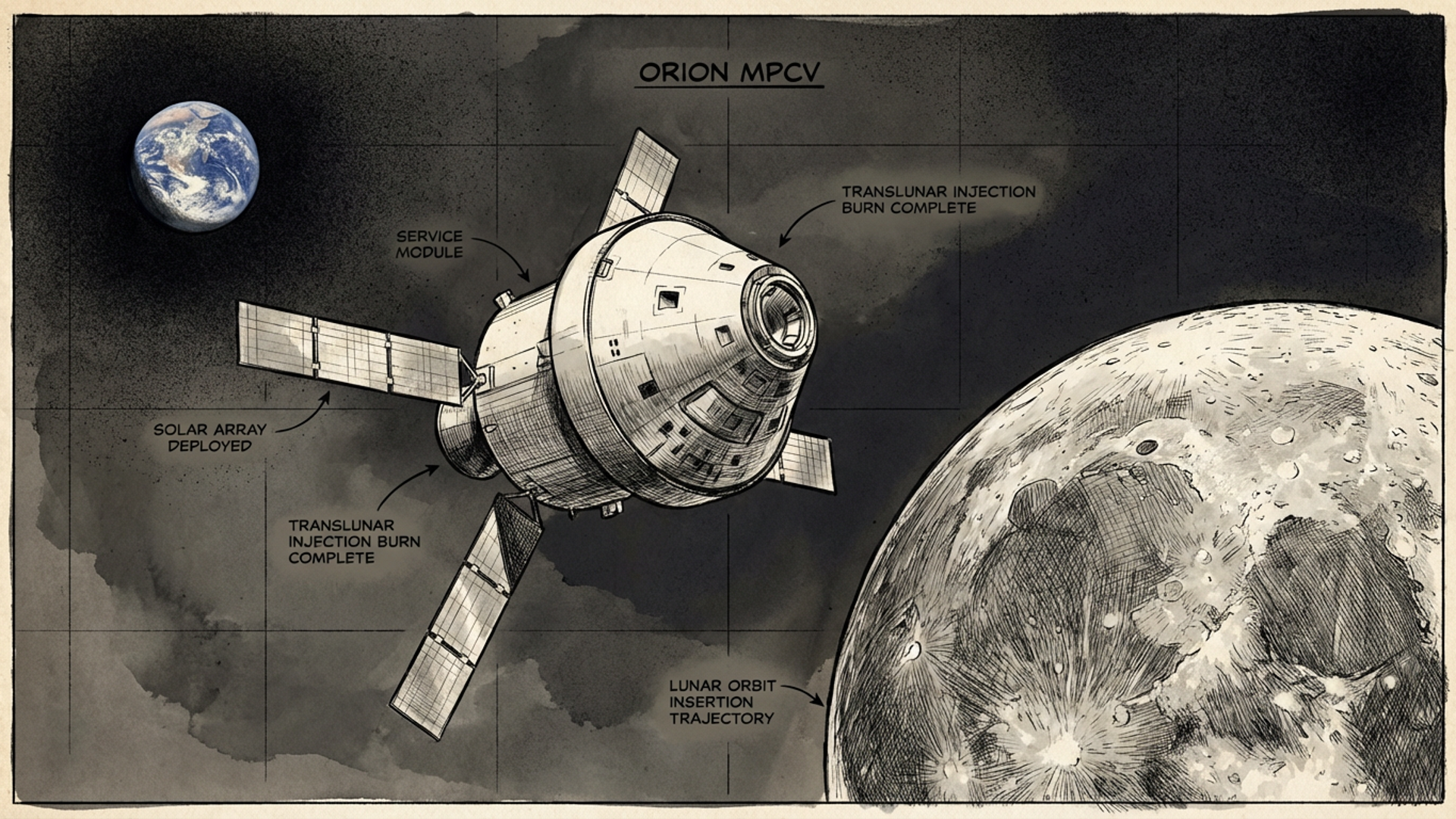
CAPE CANAVERAL, Fla. — NASA’s Artemis II crew has completed the mission’s critical translunar injection burn and is now on a free-return path around the Moon after launching this week from Kennedy Space Center, according to Reuters, Associated Press, BBC News, CNN, NBC News, and NASA. Each of the bullet points immediately below have been confirmed by at least four of the six respected sources we curated on this story.
- Artemis II lifted off from NASA’s Kennedy Space Center on April 1 at about 6:35 p.m. ET, launching Orion atop the Space Launch System rocket on the first crewed Artemis flight.
- The mission is carrying four astronauts—Reid Wiseman, Victor Glover, Christina Koch, and Jeremy Hansen—on the first crewed journey beyond Earth orbit since Apollo 17 in 1972.
- Mission planners describe Artemis II as an approximately 10-day lunar flyby test flight designed to validate spacecraft systems and procedures before later crewed landing missions.
- After initial checkouts in high Earth orbit, Orion completed a translunar injection burn and entered a free-return trajectory that loops around the Moon and returns to Earth.
- The mission is expected to culminate in Pacific splashdown after the lunar flyby, with performance data feeding NASA’s broader Artemis campaign and future deep-space operations.
Additional Details Reported
Onboard operations and anomalies
Associated Press reported that Artemis II’s onboard toilet system experienced an early malfunction, prompting mission control to direct use of backup waste-management procedures while engineers reviewed options.
Communications and trajectory milestones
NBC News reported a temporary post-launch communications handover issue that was later restored, while CNN detailed upcoming trajectory-correction events and expected blackout periods as Orion passes the Moon’s far side.
Distance records and mission context
BBC News and Reuters said Artemis II could surpass Apollo 13’s crew-distance benchmark, depending on final trajectory details, as NASA uses this mission to de-risk follow-on lunar surface operations.
Image Attribution
Attribution: AI-generated image (Hedra.com for EOBS.biz)
How we report: We select the day’s most important stories, confirm facts across multiple reputable sources, and avoid anonymous sourcing. Our goal is clear, balanced coverage you can trust—because transparency and verification matter for informed readers.