
FUKUOKA, Japan — Scientists have successfully achieved an unprecedented 130% energy conversion efficiency in solar cell technology by utilizing a specialized molybdenum-based “spin-flip” metal complex to multiply energy carriers. This breakthrough research, conducted jointly by teams at Kyushu University and Johannes Gutenberg University Mainz, was detailed by ScienceDaily, SciTechDaily, Interesting Engineering, Kyushu University, EurekAlert, and Mirage News. Each of the bullet points immediately below have been confirmed by at least four of the six respected sources we curated on this story.
- A collaborative research team from Japan’s Kyushu University and Germany’s Johannes Gutenberg University Mainz has developed a new method to capture and multiply energy from sunlight.
- The novel approach reached a quantum yield of approximately 130%, officially breaking the traditional 100% efficiency ceiling known as the Shockley-Queisser limit.
- The researchers utilized a molybdenum-based metal complex, functioning as a “spin-flip” emitter, to harvest the multiplied energy.
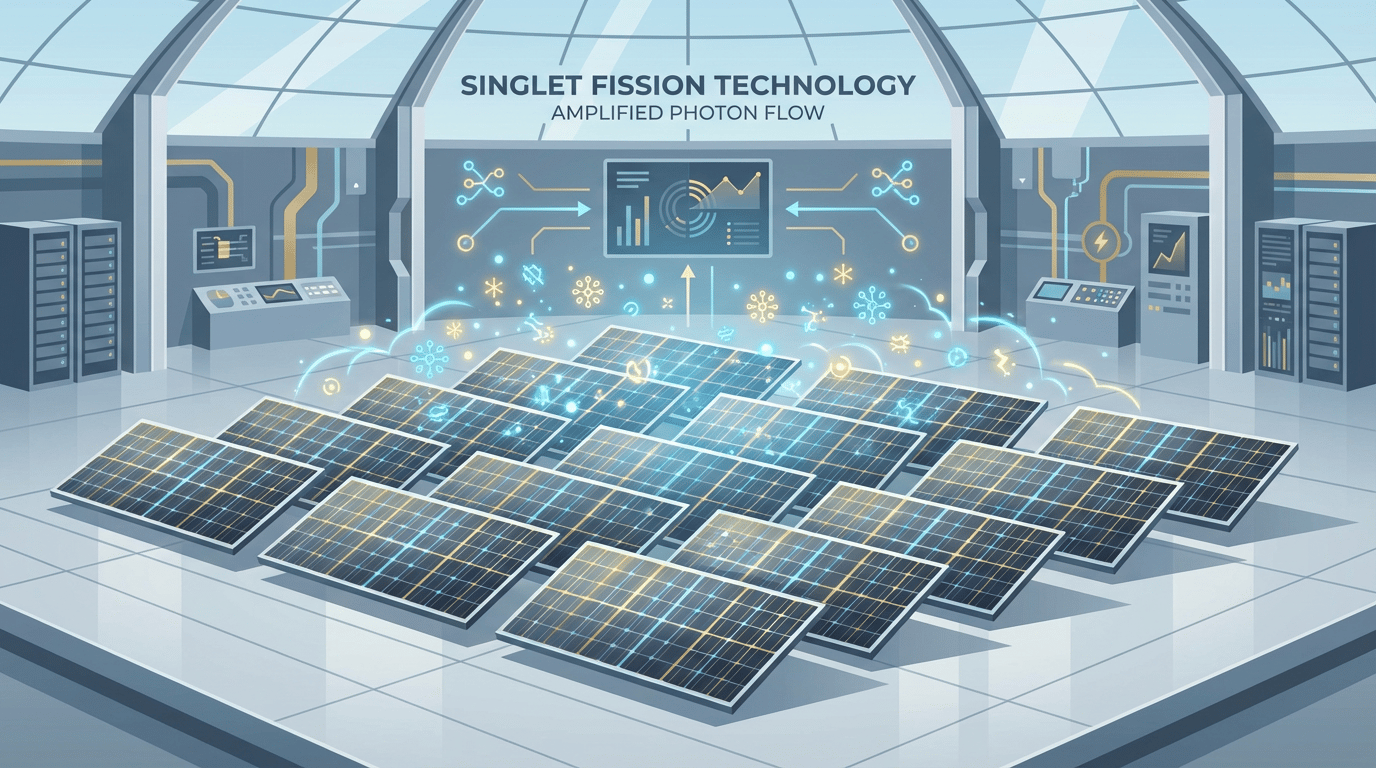
- The mechanism relies on a process called singlet fission, which allows a single absorbed high-energy photon to be split into two lower-energy excitons.
- The groundbreaking findings were published on March 25 in the peer-reviewed Journal of the American Chemical Society.
Additional Details Reported
The singlet fission process is highly regarded within the field, frequently described by researchers as a “dream technology” for advancing light conversion capabilities. However, capturing the generated energy without losing it has historically proven challenging. Associate Professor Yoichi Sasaki noted that energy is often lost through a mechanism called Förster resonance energy transfer (FRET) before it can be effectively utilized.
By pairing the newly designed molybdenum complex with tetracene-based materials in a liquid solution, the team managed to suppress this wasteful energy transfer. The precisely engineered spin-flip emitter allows an electron to change its spin while absorbing near-infrared light, selectively capturing the multiplied triplet excitons without falling prey to FRET losses. As a result, approximately 1.3 metal complexes were excited for every single photon the system absorbed.
The collaboration was sparked when Adrian Sauer, a graduate student from JGU Mainz, recognized the potential of combining the specific materials during an exchange visit to Kyushu University. While the current breakthrough remains at the proof-of-concept stage, the researchers are planning to transition the liquid solution into a solid-state system. If successful, this integration could lead to highly practical advancements not only for commercial solar cells but also for light-emitting diodes (LEDs) and emerging quantum technologies.
Image Attribution
Attribution: AI-generated image (Hedra.com for EOBS.biz)
How we report: We select the day’s most important stories, confirm facts across multiple reputable sources, and avoid anonymous sourcing. Our goal is clear, balanced coverage you can trust—because transparency and verification matter for informed readers.