
Radar data suggest vast lava tube beneath Venus
WASHINGTON — A fresh reanalysis of radar data from NASA’s Magellan mission indicates a vast underground cavity on Venus consistent with a lava tube — the first subsurface feature ever detected on the planet, according to Reuters and the study published in Nature Communications.
Researchers say the signal appears on the western flank of Nyx Mons, a large shield volcano in Venus’s northern hemisphere, where surface pits point to collapsed sections above a subterranean conduit, as described in Reuters and detailed in Phys.org’s summary of the paper.
What the reanalysis found
The team revisited Magellan’s 1990–1992 synthetic aperture radar observations and applied newer detection methods to isolate reflections consistent with an empty cavity, a technique outlined by the authors in Nature Communications.
Their interpretation points to a tube roughly a kilometer wide with a roof at least 150 meters thick — dimensions comparable to large lava tubes on Earth and the moon — figures cited by Reuters and echoed in Phys.org.
Why it matters
If confirmed, the find would open a new window on Venus’s volcanic history and subsurface processes, helping explain how lava shaped the planet’s surface and how heat continues to move through its crust, the authors wrote in Nature Communications.
Lava tubes also matter for future exploration because they could preserve signs of past geology away from the planet’s harsh surface conditions — a point emphasized by the researchers and summarized by Phys.org.
Next steps for Venus
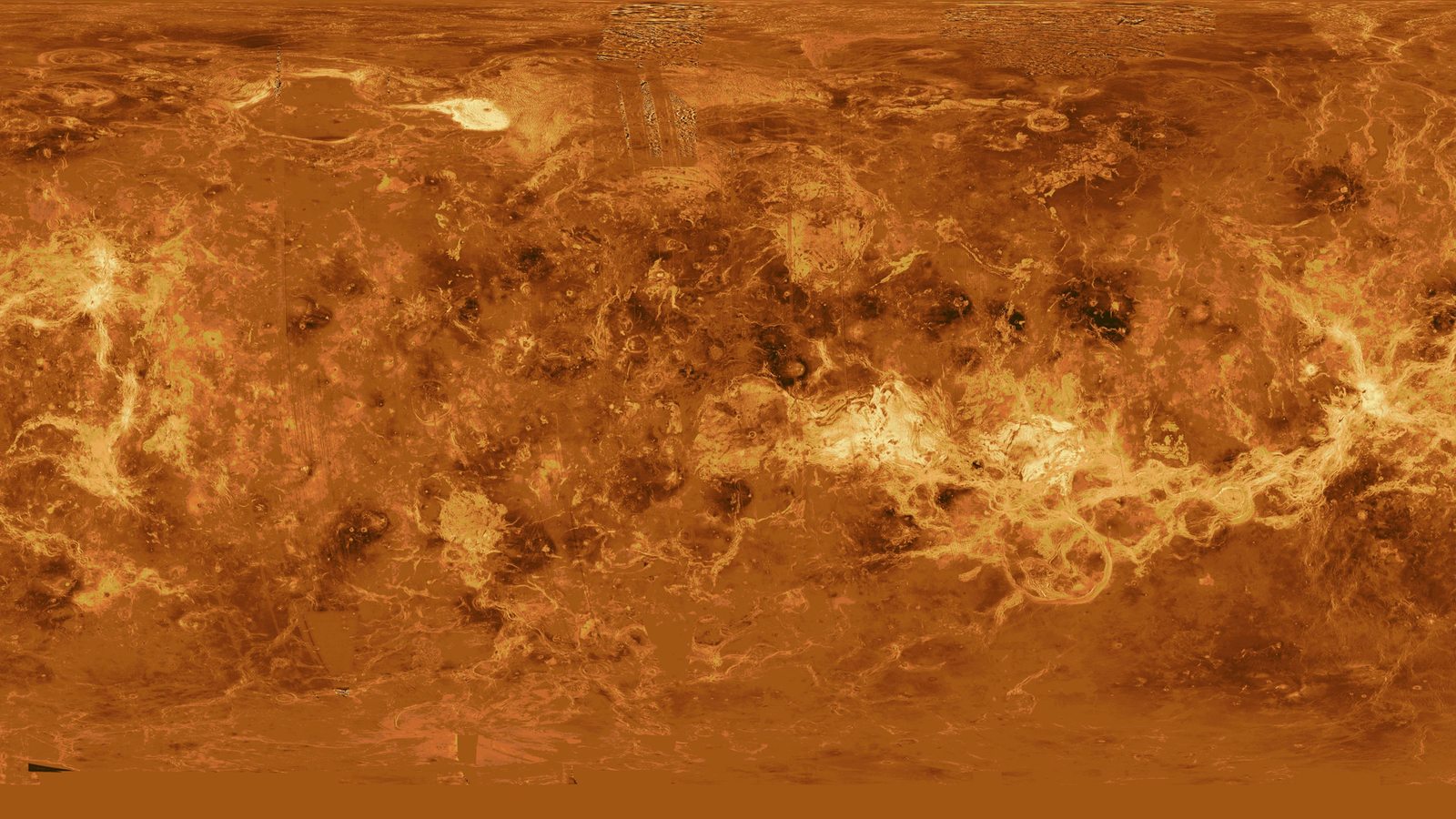
Magellan mapped roughly 98% of Venus’s surface, but radar data at this scale have limits; researchers say new missions with modern instruments will be needed to confirm the tube’s size and structure, as noted by Reuters and in the Nature Communications report.
Several planned Venus missions in the 2030s could provide that higher‑resolution look, potentially turning a decades‑old dataset into a roadmap for the next era of Venus exploration, according to Phys.org.
How we report: We select the day’s most important stories, confirm facts across multiple reputable sources, and avoid anonymous sourcing. Our goal is clear, balanced coverage you can trust—because transparency and verification matter for informed readers.
Image Attribution ▾
Image: Cylindrical Map of Venus (Magellan radar mosaic) by NASA / Jet Propulsion Laboratory, Public domain (NASA). Source: Wikimedia Commons. License: Public domain (NASA). Modifications: cropped to 16:9 and resized to 1920×1080.